
Forged vs Cast Steel Flanges: Key Differences & High-Pressure Use
Forged vs Cast Steel Flanges: Key Differences & High-Pressure Use
Introduction
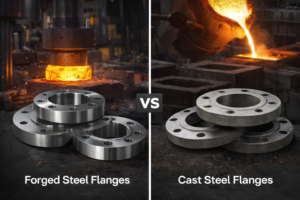
Forged vs cast steel flanges are widely used in industrial piping systems across oil & gas, petrochemical plants, refineries, power generation, and process industries.Steel flanges are vital components in industrial piping systems, widely used in oil & gas, petrochemical plants, refineries, power generation, fertilizers, and process industries. One of the most common questions asked by engineers and procurement teams is:
Should we use forged steel flanges or cast steel flanges?
The answer depends on operating pressure, temperature, safety requirements, and application criticality. This blog explains the key differences between forged and cast steel flanges and why forged flanges are preferred for high-pressure industrial applications.
https://steelflangemfg.com/flanges-2/
What Are Forged Steel Flanges?
Forged steel flanges are manufactured by heating solid steel billets and shaping them under high pressure. This process refines the internal grain structure, resulting in superior strength and reliability.
Advantages of Forged Steel Flanges:
-
Dense and uniform grain structure
-
High tensile and yield strength
-
Excellent resistance to pressure and fatigue
-
Longer service life
-
Ideal for high-pressure and critical applications
What Are Cast Steel Flanges?
Cast steel flanges are produced by melting steel and pouring it into molds. After solidification, they are machined to final dimensions.
Characteristics of Cast Steel Flanges:
-
Suitable for complex shapes
-
Lower initial cost
-
Used mainly in low-pressure or non-critical services
Casting may introduce defects such as porosity and shrinkage, which limits performance under high pressure.
Forged vs Cast Steel Flanges – Key Differences
| Parameter | Forged Steel Flanges | Cast Steel Flanges |
|---|---|---|
| Manufacturing Process | Forged under high pressure | Molten metal poured into molds |
| Grain Structure | Dense & refined | Non-uniform |
| Mechanical Strength | Very high | Moderate |
| Pressure Handling | Excellent | Limited |
| Fatigue Resistance | High | Lower |
| Defect Risk | Minimal | Higher |
| Applications | High-pressure & critical | Low-pressure |
Which Is Better for High-Pressure Applications?

For high-pressure and high-temperature services, forged steel flanges are the preferred choice. Their superior mechanical properties and reliability make them suitable for critical industries such as oil & gas, refineries, power plants, and chemical processing.
Materials Used in Forged Steel Flanges
https://steelflangemfg.com/flanges-2/
-
Stainless Steel: SS 304, 304L, 316, 316L, 321, 904L
-
Duplex & Super Duplex Stainless Steel
-
High Nickel Alloys: Monel, Inconel, Titanium, Hastelloy, Cupro-Nickel
Material selection depends on corrosion resistance, temperature, pressure, and service environment.
Standards & Pressure Ratings
Forged steel flanges are manufactured as per international standards:
-
ASTM A182, ASTM A240
-
ASME / ANSI
-
DIN, BS, JIS
Pressure Ratings Available:
-
ASA Class 150 / 300 / 600 / 900 / 1500 / 2500
-
PN 6 / PN 10 / PN 16 / PN 25 / PN 40
-
BS 10 Table D, E & F
Conclusion
While both forged and cast steel flanges have their uses, forged steel flanges offer superior strength, reliability, and safety for high-pressure industrial applications. Choosing forged flanges ensures long-term performance, reduced risk of failure, and compliance with stringent project standards.
👉 For high-quality forged steel flanges, rings, and forged & machined components, visit:
www.steelflangemfg.com