
ASTM A182 F316 vs F316L Flanges: Differences, Applications and How to Choose
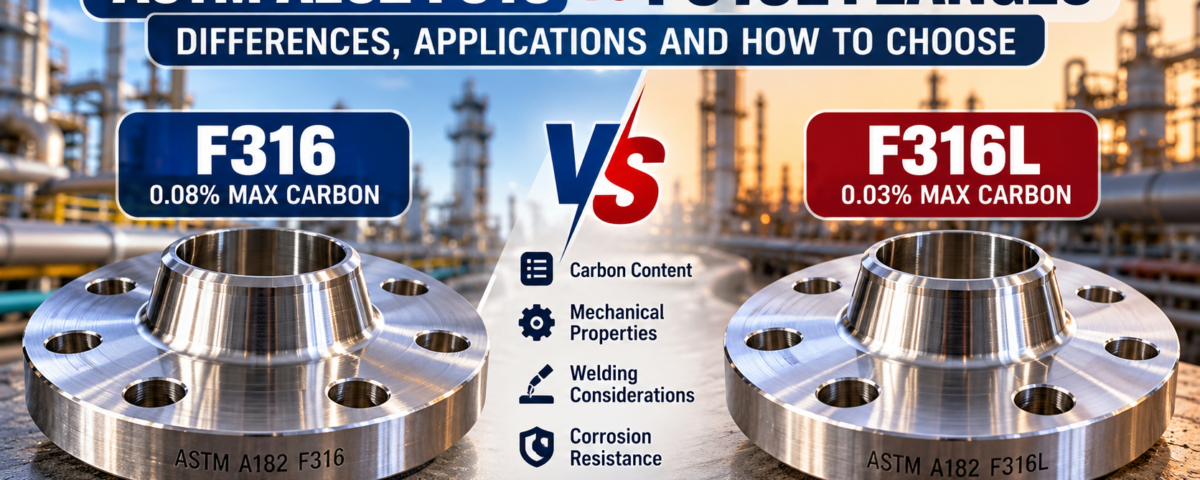
ASTM A182 F316 vs F316L Flanges: Differences, Applications and How to Choose
https://www.linkedin.com/feed/update/urn:li:activity:7506242364286390273

https://steelflangemfg.com/flanges-2/
Choosing the right stainless steel flange is an important decision in industrial piping design. Material grade affects mechanical properties, corrosion resistance, fabrication requirements and suitability for the intended operating environment.
ASTM A182 F316 and ASTM A182 F316L are two commonly specified forged stainless steel grades used in industrial piping systems. Although they share similar alloying elements, their differences in carbon content and specified mechanical properties can influence material selection.
For engineers, procurement managers, EPC contractors and industrial buyers, understanding these differences helps ensure that the selected flange meets the project’s technical requirements.
In this guide, we explain the differences between ASTM A182 F316 and F316L flanges, compare their key properties, discuss their applications and provide practical guidance for selecting the appropriate grade.
What Is ASTM A182 F316?
ASTM A182 F316 is a molybdenum-bearing austenitic stainless steel forging grade used for flanges and other specified piping components.
The addition of molybdenum improves resistance to certain forms of corrosion, particularly pitting and crevice corrosion, compared with grades such as 304 in many environments.
F316 flanges may be specified in chemical processing, industrial fluid handling, selected oil and gas services and other applications where the material’s properties are suitable.
However, the grade should always be assessed against the actual operating conditions, including fluid chemistry, temperature, pressure and exposure to corrosive substances.
What Is ASTM A182 F316L?
ASTM A182 F316L is the low-carbon version of F316. The letter “L” stands for low carbon.
The lower carbon limit helps reduce the risk of sensitisation during certain welding and thermal exposure conditions. Sensitisation can occur when chromium carbides form at grain boundaries, potentially reducing local corrosion resistance.
For this reason, F316L is often specified for fabricated stainless steel piping assemblies where welding-related corrosion concerns are important.
Like F316, F316L contains chromium, nickel and molybdenum. Its suitability still depends on the specific service environment and the applicable engineering specification.
ASTM A182 F316 vs F316L: Key Differences
The principal difference between these two grades is their permitted carbon content. Their minimum specified mechanical properties also differ.
| Property | ASTM A182 F316 | ASTM A182 F316L |
|---|---|---|
| Stainless steel family | Austenitic | Austenitic |
| UNS designation | S31600 | S31603 |
| Maximum carbon content | 0.08% | 0.03% |
| Chromium content | Typically 16–18% | Typically 16–18% |
| Nickel content | Typically 10–14% | Typically 10–14% |
| Molybdenum content | Typically 2–3% | Typically 2–3% |
| Typical minimum tensile strength | 515 MPa (75 ksi) | 485 MPa (70 ksi) |
| Typical minimum yield strength | 205 MPa (30 ksi) | 170 MPa (25 ksi) |
| Key consideration | Higher minimum specified strength | Lower carbon content |
Technical note: The composition ranges and mechanical properties shown are general reference values. Verify the applicable ASTM A182 edition, product requirements and material test certificate before using them for engineering acceptance or design.
1. Carbon Content
F316 permits a maximum carbon content of 0.08%, while F316L permits a maximum of 0.03%.
This distinction is particularly relevant during welding. Under certain thermal conditions, higher carbon content can increase the risk of chromium carbide precipitation at grain boundaries.
F316L’s lower carbon limit helps reduce this risk, making it a common choice for welded stainless steel assemblies.
2. Mechanical Properties
F316 generally has higher minimum specified tensile and yield strength requirements than F316L under commonly referenced ASTM A182 requirements.
However, the grade with the higher minimum strength is not automatically the better choice for every application.
Engineers must consider the applicable design code, component dimensions, pressure-temperature ratings, operating loads and material requirements before selecting a grade.
3. Welding Considerations
F316L is often preferred when reducing the risk of weld-related sensitisation is important.
F316 can also be welded using suitable qualified procedures, but the material condition, welding process, service environment and applicable project requirements must be considered.
Low carbon content does not eliminate the need for appropriate welding procedures, cleaning, inspection and fabrication controls.
4. Corrosion Resistance
Both grades contain molybdenum, which can improve resistance to pitting and crevice corrosion in certain environments.
Because their principal alloying elements are similar, F316 and F316L can offer comparable corrosion resistance in many applications.
Neither grade is universally suitable for all chloride-containing environments. Seawater exposure, elevated temperatures, chemical concentrations and crevice conditions may require a different material selection.
5. Cost and Availability
The commercial price of F316 and F316L flanges depends on size, pressure class, flange type, manufacturing route, quantity, availability, inspection requirements and market conditions.
F316L may be preferred in certain welded applications, while F316 may be specified where its properties meet the design requirements.
Buyers should compare quotations against the same technical specification rather than selecting a grade based on price alone.
Applications of ASTM A182 F316 and F316L Flanges
The appropriate grade depends on the process conditions and approved piping specification.
Chemical Processing Industry
F316 and F316L may be used for selected process piping, fluid transfer lines and associated equipment when the material is compatible with the chemicals, concentrations and operating temperatures involved.
Oil and Gas Industry
These grades can be specified for suitable process and utility piping systems. Actual suitability depends on the service fluid, pressure, temperature, corrosion risks and project-specific material requirements.
Food and Pharmaceutical Processing
F316L is often considered for welded stainless steel assemblies where low carbon content and suitable fabrication practices are important.
The material grade alone does not establish compliance with sanitary, pharmaceutical or food-contact requirements. Surface finish, fabrication, cleaning and applicable regulations must also be considered.
Marine and Coastal Applications
The molybdenum content of F316 and F316L can improve resistance to certain corrosion mechanisms. However, prolonged seawater exposure can be demanding, and duplex or super duplex stainless steel may be more appropriate in some conditions.
Power and General Industrial Piping
These grades may be used in selected utility, process and industrial piping applications where the specified material properties satisfy the design and operating requirements.
Which Is Better: F316 or F316L?
There is no single grade that is best for every application.
Choose F316 when:
- The approved material specification explicitly requires F316.
- Its specified mechanical properties meet the design requirements.
- The fabrication process and service environment are suitable for the grade.
Choose F316L when:
- The purchase specification requires the low-carbon grade.
- Welding-related sensitisation is an important consideration.
- The project requires compliance with the F316L carbon limit.
What about dual-certified F316/F316L material?
Some material may be supplied with dual certification when the test results satisfy the requirements of both grades.
Buyers should verify the material test certificate and confirm that dual certification is permitted by the applicable project specification. It should never be assumed from the product description alone.
The final decision should be based on the approved piping class, design requirements, fabrication conditions and service environment.
How to Select the Right ASTM A182 F316 or F316L Flange
https://steelflangemfg.com/flange-manufacturing-process/
Before ordering, engineers and procurement teams should verify the following details.
1. Material Grade
Confirm whether F316 or F316L is specified. If an alternative or dual-certified material is proposed, obtain approval before substitution.
2. Flange Standard
Specify the applicable dimensional standard. ASME B16.5 is commonly used for pipe flanges and flanged fittings within its stated scope. Other projects may require different standards.
ASTM A182 defines material requirements, while ASME B16.5 addresses flange dimensions, pressure-temperature ratings, marking and related requirements. These standards serve different purposes.
3. Size and Pressure Class
Specify the nominal pipe size and required pressure class. Confirm that the selected flange meets the design conditions and applicable pressure-temperature ratings.
4. Flange Type and Facing
Identify whether the requirement is for a weld neck, slip-on, blind, socket weld or another flange type. Specify the required facing, such as raised face, flat face or ring-type joint, as applicable.
5. Inspection and Documentation
Confirm the required material test certificates, dimensional inspection records, traceability, non-destructive testing and any additional inspection requirements specified in the purchase order.
6. Service Conditions
Provide relevant information about operating pressure, temperature, fluid composition and corrosion exposure so that the material selection can be reviewed against the intended service.
What Should Buyers Check in an F316 or F316L Material Test Certificate?
A Material Test Certificate (MTC) helps buyers verify the reported material composition and mechanical test results.
For F316 and F316L flanges, important checks include:
- The stated material grade and applicable specification.
- The reported carbon content, especially for F316L.
- Chemical composition and mechanical test results.
- Heat number or other required material identification.
- Consistency between product markings and documentation.
- Compliance with any additional requirements in the purchase order.
Documentation requirements can vary by project and certificate type. Buyers should verify the actual records rather than relying solely on a supplier’s general product description.
Stainless Steel Flanges from Steel Flange MFG. Co.
Steel Flange MFG. Co. is an Indian manufacturer and exporter of steel flanges, forgings, rings and machined components.
Our product range includes stainless steel, carbon steel, duplex, super duplex and high-nickel alloy products, subject to the specified requirements.
For an enquiry involving ASTM A182 F316 or F316L flanges, buyers can provide the required material grade, size, flange type, pressure class, applicable standard, quantity and documentation requirements.
Visit https://steelflangemfg.com/ to explore our product range and contact our team regarding your requirements.
Frequently Asked Questions
What is the difference between ASTM A182 F316 and F316L flanges?
The main difference is the carbon limit. F316 permits up to 0.08% carbon, while F316L permits up to 0.03%. Their minimum specified mechanical properties also differ.
Is F316L better than F316 for welding?
F316L is often preferred when low carbon content is important for reducing the risk of sensitisation during welding. The final choice depends on the material specification, fabrication procedure and service conditions.
Are F316 and F316L flanges dimensionally different?
Not simply because of the material grade. Flange dimensions depend on the specified size, type, pressure class, facing and dimensional standard.
Can F316L flanges be used in seawater?
Suitability cannot be assumed from the grade alone. Seawater can cause pitting and crevice corrosion, so the operating environment must be assessed. A more corrosion-resistant alloy may be required.
What is the UNS designation for F316 and F316L?
The commonly associated UNS designations are S31600 for Type 316 and S31603 for Type 316L. Buyers should confirm the designation against the applicable material specification and certificate.
What does dual-certified F316/F316L mean?
It means the material is documented as meeting the applicable requirements of both grades. The certificate should demonstrate compliance with the required chemical composition and mechanical properties.
Which information should I provide for a flange quotation?
Provide the material grade, flange standard, nominal size, pressure class, flange type, facing, quantity, delivery destination and required inspection documentation.
Conclusion
ASTM A182 F316 and F316L are closely related austenitic stainless steel forging grades, but their differences matter when selecting industrial flanges.
F316 has higher minimum specified strength in commonly referenced requirements, while F316L’s lower carbon limit can be advantageous for welded applications where sensitisation is a concern.
For industrial buyers, the right grade is the one that satisfies the project’s material, mechanical, fabrication and service requirements.
Looking for stainless steel flanges for your next project? Contact Steel Flange MFG. Co. with your technical specifications to discuss your requirements.
mumbai@steelflangemfg.com