
Stainless Steel Flange Manufacturer in India: Grades, Standards, Manufacturing & Export Guide
Stainless Steel Flange Manufacturer in India: Grades, Standards, Manufacturing & Export Guide
When an industrial project requires a reliable connection between pipes, valves, pumps, vessels, and other piping components, stainless steel flanges play an important role. The right flange must not only match the required dimensions and pressure rating but also provide suitable corrosion resistance, mechanical strength, durability, and dimensional accuracy.
For procurement teams, engineers, EPC contractors, and international buyers, choosing the right stainless steel flange manufacturer in India is therefore an important purchasing decision.
India has a strong manufacturing base for forged and machined industrial components, but not every supplier offers the same combination of material range, manufacturing capability, inspection, documentation, customization, and export support.
This guide explains what buyers should look for when sourcing stainless steel flanges and how to evaluate a reliable manufacturer.
What Are Stainless Steel Flanges?
https://steelflangemfg.com/flanges-2/
Stainless steel flanges are mechanical components used to create detachable connections between piping components.
A flanged connection generally allows equipment and piping sections to be assembled, inspected, maintained, and replaced more conveniently than permanently welded connections.
Depending on the application, stainless steel flanges can be supplied in different designs, pressure classes, dimensions, facing types, and material grades.
Common types include:
- Weld Neck Flanges
- Slip On Flanges
- Blind Flanges
- Socket Weld Flanges
- Threaded Flanges
- Lap Joint Flanges
- Spectacle Blind Flanges
- Ring Type Joint Flanges
- Custom-designed flanges
The selection depends on factors such as piping design, pressure, temperature, material compatibility, connection method, and project specifications.
Why Are Stainless Steel Flanges Used in Industrial Applications?
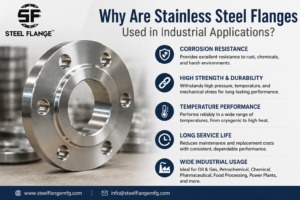
Stainless steel is widely selected for applications where corrosion resistance and material performance are important.
Depending on the grade, stainless steel flanges can offer:
Corrosion Resistance
Stainless steel can provide strong resistance to corrosion in many industrial environments.
This makes it suitable for applications involving moisture, chemicals, process fluids, and demanding operating conditions.
High Mechanical Strength
Appropriate stainless steel grades can provide the strength required for industrial piping and equipment connections.
Temperature Performance
Material selection becomes especially important in applications involving elevated or changing temperatures. The appropriate grade must be selected according to the project design conditions.
Long Service Life
When the correct material, design, manufacturing process, and installation practices are used, stainless steel components can provide dependable long-term performance.
Common Stainless Steel Flange Grades
One of the first decisions when purchasing stainless steel flanges is selecting the correct material grade.
Common grades include:
Stainless Steel 304
304 is one of the most widely used stainless steel grades for general industrial applications.
It is commonly considered where good corrosion resistance, fabrication characteristics, and general-purpose performance are required.
Stainless Steel 304L
304L is the low-carbon version of 304 and is frequently selected for applications where welding considerations are important.
Stainless Steel 316
316 contains molybdenum and is commonly selected for applications requiring improved resistance to certain corrosive environments compared with 304.
Stainless Steel 316L
316L is a low-carbon version of 316 and is widely used in process, chemical, pharmaceutical, marine, and other applications where corrosion resistance and welding considerations are important.
Stainless Steel 321
321 is stabilized with titanium and can be selected for certain elevated-temperature applications.
Stainless Steel 904L
904L is a high-alloy austenitic stainless steel designed for demanding corrosion environments.
Duplex and Super Duplex Stainless Steel
Duplex and super duplex grades combine characteristics of austenitic and ferritic stainless steels and can be considered for demanding applications requiring high strength and corrosion resistance.
Stainless Steel Flange Standards
A professional manufacturer should be able to understand the standard required by the customer’s project.
Depending on the application and market, stainless steel flanges may be manufactured according to standards and specifications such as:
- ASME
- ASTM
- ANSI
- DIN
- BS
- JIS
- Customer drawings and specifications
For ASME B16.5 applications, buyers commonly specify flange size, pressure class, facing, bore, material specification, and other dimensional requirements.
The important point is that the flange should be manufactured according to the complete applicable specification, not simply according to the product name.
Stainless Steel Flange Pressure Classes
Industrial flanges are available in different pressure ratings.
Common ASME pressure classes include:
- Class 150
- Class 300
- Class 600
- Class 900
- Class 1500
- Class 2500
Metric systems may use PN ratings such as PN6, PN10, PN16, PN25, and PN40.
The required pressure rating should always be determined according to the piping system design and applicable engineering specification.
How Are Stainless Steel Flanges Manufactured?
Manufacturing quality has a direct impact on the performance of a flange.
A typical manufacturing route may involve several stages.
1. Raw Material Selection
Production begins with the required stainless steel grade and material specification.
Material documentation and identification are important at this stage.
2. Material Inspection
The material can be checked against the specified chemical and mechanical requirements.
Where required, material identification and testing can also be carried out.
3. Forging
For forged flange requirements, controlled forging processes are used to produce the required shape and improve material integrity.
4. Heat Treatment
Depending on the material grade and specification, appropriate heat treatment may be required.
5. Machining
Precision machining is carried out to achieve the required dimensions, bore, flange thickness, bolt holes, facing, grooves, and other features.
6. Dimensional Inspection
Critical dimensions are checked against applicable standards or customer drawings.
7. Testing and Inspection
Additional inspection or testing may be performed according to project requirements.
8. Marking
Product identification can include information such as material grade, size, pressure class, standard, heat number, and manufacturer identification, depending on requirements.
9. Packing
The finished flanges are protected and packed for transportation, with export packing available according to shipment requirements.
How to Choose a Stainless Steel Flange Manufacturer in India
Choosing a supplier only on the basis of the lowest quotation can create problems later.
International buyers should evaluate the complete manufacturing and supply capability.
Here are some important factors to consider.
1. Check the Material Range
Does the manufacturer supply only common grades such as 304 and 316, or can they also manufacture duplex, super duplex, 321, 904L, and nickel alloy products?
A wider material capability can be useful for companies handling different industrial projects.
2. Check Manufacturing Capability
Ask whether the manufacturer has the capability for:
- Forging
- Machining
- Drilling
- Facing
- Custom manufacturing
- Special dimensions
- Customer drawings
This can be especially important when standard catalogue dimensions are not sufficient.
3. Ask About Inspection and Documentation
A reliable supplier should be able to explain how material and finished-product quality are controlled.
Depending on the order, buyers may require documentation such as:
- Mill Test Certificate
- Dimensional Inspection Report
- PMI Report
- Heat Treatment Records
- NDT Reports
- Certificate of Conformity
- Other project-specific inspection documents
4. Evaluate Export Experience
For international buyers, manufacturing capability is only one part of the supply chain.
The supplier should also understand:
- Export packing
- Shipping documentation
- International freight coordination
- Customer-specific marking
- Inspection requirements
- Delivery schedules
5. Look for Custom Manufacturing Capability
Industrial projects frequently require customized dimensions or products manufactured according to drawings.
A manufacturer capable of producing custom stainless steel flanges can be more useful than a supplier limited to standard products.
6. Review Quality Certifications and Approvals
Buyers should review the manufacturer’s applicable certifications, approvals, quality systems, and project experience before placing an order.
The exact certification or approval requirements should be matched to the customer’s industry and project specification.
Stainless Steel Flanges for Different Industries
Stainless steel flanges are used across a wide range of industrial sectors.
Oil & Gas
Flanges are used throughout piping systems, process equipment, terminals, and related infrastructure.
Petrochemical and Refineries
Corrosion resistance, material compatibility, pressure rating, and documentation are particularly important in refinery and petrochemical applications.
Chemical Industry
Chemical processing environments can require carefully selected stainless steel and high-alloy materials.
Power Generation
Flanged connections are used in multiple piping and equipment systems within power plants.
Pharmaceutical and Food Processing
Applications with strict hygiene and corrosion-resistance requirements may use appropriate stainless steel grades and surface finishes.
Water Treatment
Stainless steel components can be selected for applications where corrosion resistance and long-term service are important.
Why Indian Flange Manufacturers Are Considered by Global Buyers
India has become an important sourcing destination for engineering and industrial components.
For international buyers, the advantages can include:
- Broad manufacturing capabilities
- Competitive production costs
- Engineering expertise
- Multiple material options
- Custom manufacturing
- Export experience
- Availability of forged and machined components
However, buyers should evaluate suppliers individually rather than assuming that every manufacturer provides the same quality or documentation.
Why Buyers Should Not Choose Flanges on Price Alone
A low initial price does not necessarily represent the lowest total procurement cost.
Problems with incorrect material, poor machining, dimensional deviations, inadequate documentation, unsuitable packing, or delivery delays can create much larger costs during a project.
A better procurement approach considers:
Material + Manufacturing + Inspection + Documentation + Packing + Delivery + Supplier Reliability
The objective should be to purchase the correct flange for the application, not simply the cheapest flange available.
Stainless Steel Flange Manufacturer in India – Steel Flange MFG. Co.
Steel Flange MFG. Co. manufactures and supplies industrial flanges, rings, forgings, and machined components for domestic and international requirements.
Our product range includes stainless steel grades such as 304, 304L, 316, 316L, 321, 904L, duplex, super duplex, and high-nickel alloys, subject to product and project requirements.
We manufacture products according to applicable standards and customer specifications, including customized drawings and dimensions.
Our capabilities support requirements across industries such as:
- Oil & Gas
- Petrochemical
- Refineries
- Chemical Processing
- Power Plants
- Engineering
- Industrial Piping
- Process Equipment
For international buyers, we also focus on proper documentation, inspection, identification, and export-ready packing.
What Information Should You Send When Requesting a Flange Quotation?
To receive an accurate quotation quickly, buyers should provide as much technical information as possible.
A typical RFQ should include:
Product: Stainless Steel Flange
Type: Weld Neck / Slip On / Blind / Socket Weld / Other
Size: Required nominal size
Pressure Class: Class 150 / 300 / 600 / etc.
Material: SS 304 / 304L / 316 / 316L / 321 / 904L / Duplex / Other
Facing: RF / RTJ / FF
Standard: ASME / ASTM / DIN / JIS / BS / Customer Specification
Quantity: Required number of pieces
Bore / Schedule: Where applicable
Inspection: Standard or third-party inspection requirements
Documentation: MTC, PMI, inspection reports, etc.
Delivery Location: City and country
Providing these details helps the manufacturer understand the requirement correctly and prepare a more accurate quotation.
Frequently Asked Questions
Who is a stainless steel flange manufacturer in India?
A stainless steel flange manufacturer in India produces stainless steel flanges through processes such as forging and machining and supplies them according to applicable standards, material specifications, drawings, and customer requirements.
Which stainless steel is commonly used for flanges?
SS 304, 304L, 316, and 316L are widely used grades. Other grades such as 321, 904L, duplex, and super duplex may be selected for specific applications.
What is the difference between SS 304 and SS 316 flanges?
Both are austenitic stainless steels, but 316 contains molybdenum and is generally selected when improved resistance to certain corrosive environments is required.
Can stainless steel flanges be manufactured according to drawings?
Yes. Depending on the manufacturer’s capabilities, stainless steel flanges can be manufactured according to customer drawings, specifications, dimensions, and project requirements.
What documents should I request with stainless steel flanges?
Depending on the project, buyers may request MTCs, dimensional inspection reports, PMI reports, heat-treatment records, NDT reports, certificates of conformity, and other specified documentation.
Can Indian manufacturers supply stainless steel flanges internationally?
Yes. Indian manufacturers with export capabilities can supply stainless steel flanges to international markets, subject to the destination country’s requirements, project specifications, logistics, and documentation.
Final Thoughts
Selecting the right stainless steel flange manufacturer in India is about much more than comparing prices.
The right supplier should combine material knowledge, manufacturing capability, precision machining, quality inspection, documentation, customization, and reliable export support.
For critical industrial projects, the manufacturer behind the flange matters just as much as the flange specification itself.
If your project requires stainless steel flanges, forged rings, forgings, or machined components, share your size, material grade, pressure class, standard, quantity, and drawing/specification with Steel Flange MFG. Co. for a detailed quotation.
Reliable manufacturing. Precise engineering. Global supply.